
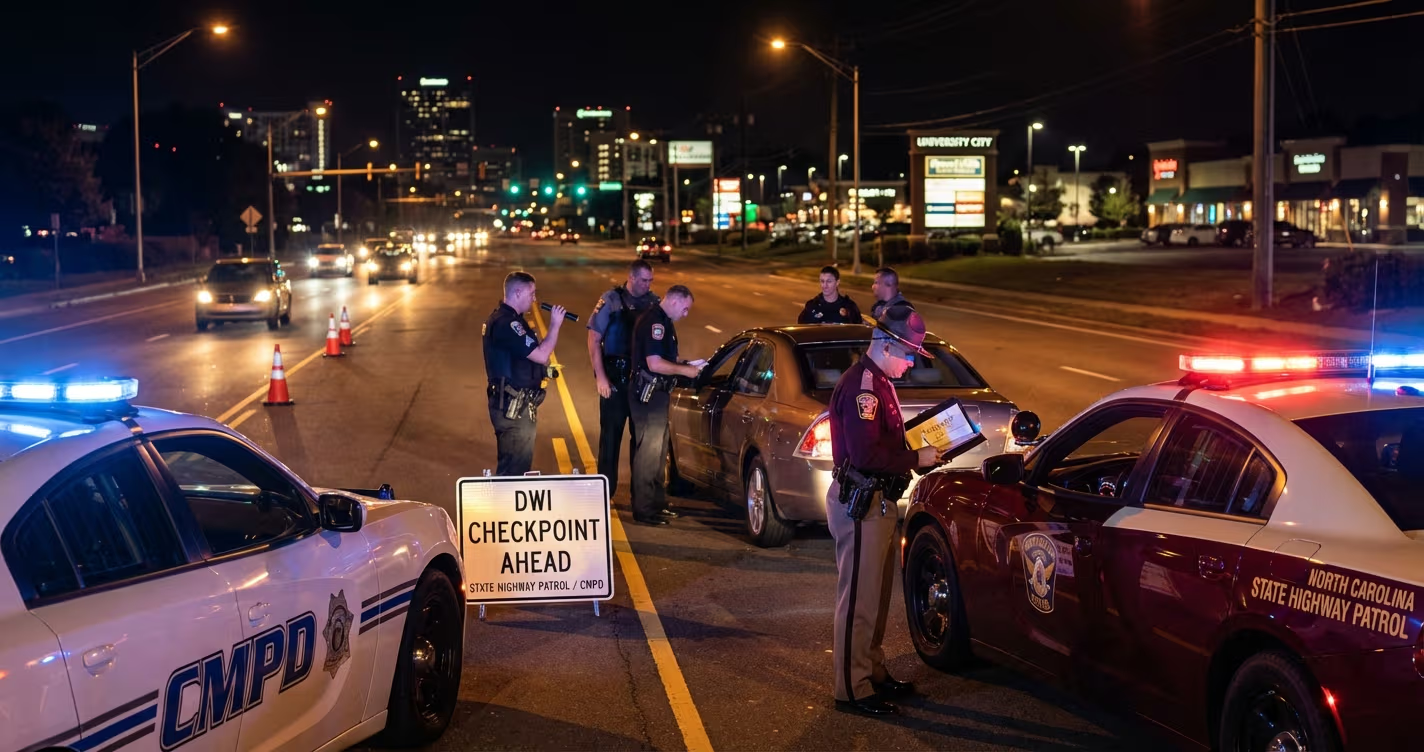
DWI Defense · Greensboro · High Point · Guilford County, NC
Charged with DWI in Greensboro? Here’s What Actually Happens Next.
A DWI conviction in North Carolina can cost you your license, your job, and your freedom. Our Board Certified criminal defense attorneys have defended hundreds of DWI cases in Guilford County — and we know exactly how to fight yours.
UNDERSTANDING YOUR CHARGE
What is Driving While Impaired in North Carolina?
In North Carolina, Driving While Impaired (DWI) is defined under N.C.G.S. § 20-138.1 as operating a vehicle on a public street or highway while under the influence of an impairing substance, with a blood alcohol concentration (BAC) of .08 or higher, or with any amount of a Schedule I controlled substance in your system.
North Carolina does not use the term "DUI." The charge is always called DWI here, and it carries some of the strictest penalties in the country. Unlike many states, NC DWI sentencing is governed by a structured points system that considers aggravating, grossly aggravating, and mitigating factors to determine your sentence level. The wrong attorney, missing a single mitigating factor, can be the difference between probation and jail time.
If you were charged with DWI anywhere in Greensboro, High Point, or Guilford County, you need to speak with an experienced DWI lawyer in Greensboro, NC as soon as possible. The clock starts the moment you're charged — civil license revocation can begin within 30 days of arrest.
If you were just arrested: You have exactly 10 days from your arrest date to request a hearing contesting your Civil Revocation — the automatic 30-day license suspension that kicks in before your case is even heard in court. Miss that window and the revocation stands with no recourse. Call us today: (336) 802-1090.
NC SENTENCING STRUCTURE
The 6 Levels of DWI in North Carolina
North Carolina's DWI sentencing structure is unlike most states. Judges assess aggravating, grossly aggravating, and mitigating factors to determine which of the six levels applies to your case. A skilled Guilford County DWI attorney can challenge how these factors are applied and, in many cases, get your level reduced.
| Grossly Aggravating Factors | Aggravating Factors | Mitigating Factors |
|---|---|---|
| Prior DWI conviction within 7 years Each prior = one grossly aggravating factor | BAC of .15 or higher | Slight impairment only (.08–.09 BAC) |
| Driving while license revoked due to prior DWI | Reckless or dangerous driving | Driving safe and lawfully except for impairment |
| Serious injury to another person in the incident | Negligent driving causing accident | Lawful BAC of .09 or below + no other impairing substance |
| Minor passenger under 18 in the vehicle | Stop or checkpoint evasion | Safe driver impairment recognition program completion |
| Passenger under 18 + BAC .15 or above | Prior DWI conviction (7+ years ago) | Valid operator's license at time of offense |
| Speeding in a school zone | Voluntary substance abuse treatment after arrest | |
| Speeding 30+ mph over the limit | No prior DWI convictions |
WHAT’S REALLY AT STAKE
A DWI Conviction in Greensboro Costs More Than You Think
Most people focused on the immediate charges — jail time and fines — but a DWI conviction in North Carolina carries consequences that follow you for years. Understanding what you're actually facing is why hiring the right Greensboro DWI lawyer matters so much.
NC imposes a Civil Revocation within 30 days of your DWI arrest— before you're even convicted. A conviction adds a minimum one-year revocation on top of that. Learn more about Civil Revocation in NC →
Unlike many states, DWI convictions in North Carolina cannot be expunged. It remains on your record permanently and may affect employment background checks, professional licensing, and housing applications.
A DWI conviction triggers an NC Safe Driver Incentive Plan (SDIP) assessment—typically 12 points—causing insurance premiums to increase dramatically for years. Some insurers may even cancel coverage altogether.
Level I, Aggravated Level I, and certain other DWI convictions require installation of an ignition interlock device at your own expense for a minimum of one year.
DWI convictions can trigger disciplinary action involving nursing, CDL, teaching, real estate, and other professional licenses. Many employers in Greensboro and Guilford County conduct routine background checks.
For non-U.S. citizens in the Greensboro and High Point area, a DWI conviction may affect immigration status or naturalization eligibility. If this applies to you, speak with our Spanish-speaking attorneys immediately.
IGNITION INTERLOCK — WHAT YOU NEED TO KNOW
When Is An Ignition Interlock Device Required in NC?
North Carolina's interlock requirements under N.C.G.S. § 20-17.8 apply to several DWI-related situations. Understanding when it applies — and how long — affects whether you can get a limited driving privilege and when your full license can be restored.
If any of the following apply to your conviction, an ignition interlock device may be required before you can receive a limited driving privilege or restore your full license:
Interlock devices must be installed by a certified NC vendor at your expense — typical cost runs $70–$100 per month for rental and monitoring. If you're facing interlock requirements, we can help you understand the timeline and what steps come before and after.
THE DWI PROCESS IN GUILFORD COUNTY
What Happens After a DWI Arrest in Greensboro?
Understanding the process is the first step toward fighting back. Here's what to expect after a DWI arrest in Guilford County:
After being stopped, the officer administers field sobriety tests and requests a breath or blood test. If you blow .08 or above—or refuse—you will be charged. The officer issues a Civil Revocation form at this point, beginning the 30-day clock on your license.
You appear before a magistrate who sets bond conditions. In some cases, a Safe Roads Assessment is ordered before release. Certain DWI arrests require waiting a minimum of four hours before release.
You have 10 days from arrest to request a hearing to challenge your Civil Revocation and potentially obtain a limited driving privilege. Miss this deadline and your license is revoked for 30 days with no recourse.
Your DWI case is heard in Guilford County District Court. Unlike most misdemeanors, DWI charges generally cannot be reduced through plea bargaining. Your options are typically dismissal, a guilty plea, or trial.
North Carolina DWI cases are bench trials in District Court, meaning they are decided by a judge rather than a jury. Your attorney may challenge the stop, cross-examine the officer, dispute chemical test results, and present available defenses.
If convicted, the judge determines your sentencing level and any conditions imposed. Your attorney can argue mitigating factors, advocate for alternatives to incarceration where permitted, and seek a limited driving privilege when available.
WHY ABERLE AND CONNOLLY
Why Clients Choose Us for DWI Defense in Greensboro
Board Certified
Fewer than 4% of NC lawyers hold Board Certification in Criminal Law. Both Brennan and Julie are certified — meaning they've passed rigorous peer review and testing in criminal defense.
Julie is a Top-3 DWI Lawyer in Greensboro
Named one of only three top DWI attorneys in Greensboro by ThreeBestRated, and Past President of the Greensboro Criminal Defense Lawyers Association.
MX - Se Habla Español
We serve the Spanish-speaking community in Greensboro and High Point. Julie Connolly is fluent in Spanish and our team includes Spanish-speaking staff to support you through every step.
Former Public Defender
Brennan's time in the Guilford County Public Defender's Office means he's argued DWI cases in these exact courtrooms — he knows the judges, the prosecutors, and the process.
We Go To Trial When It Counts
Prosecutors know which defense attorneys bluff about going to trial. We don't. Our DWI trial experience in Guilford County means our advocacy carries real weight at every stage of your case.
FREQUENTLY ASKED QUESTIONS
DWI Questions Answered Greensboro, NC
-
Yes — North Carolina only uses the term DWI (Driving While Impaired). There is no separate DUI charge in this state. Any reference to "DUI" in Greensboro or Guilford County is referring to the same charge under N.C.G.S. § 20-138.1. The law covers alcohol, illegal drugs, prescription medications, and any other impairing substance.
-
A field sobriety test is a roadside test — including the Horizontal Gaze Nystagmus, Walk-and-Turn, and One-Leg Stand — designed to help the officer determine impairment. In North Carolina, you can refuse field sobriety tests without automatic legal penalty to your license. However, refusal can still be used as evidence of impairment. Whether to refuse depends heavily on the situation — call us before your court date and we can evaluate how the refusal affects your case.
-
Refusing the breathalyzer in North Carolina triggers an automatic 1-year license revocation under the implied consent law (N.C.G.S. § 20-16.2) — separate from any DWI conviction. However, the prosecution cannot use your refusal to prove your BAC. Our attorneys regularly defend refusal cases and can challenge the revocation at a DMV hearing. Call us within 10 days of your arrest.
-
Yes. Unlike some charges, DWI in NC cannot be plea-bargained to a lesser offense — but it can absolutely be dismissed. Successful challenges to the traffic stop, breath test, or field sobriety test administration can result in a full dismissal. Cases can also be dismissed for procedural errors, constitutional violations, or insufficient evidence. This is why having a Board Certified DWI attorney in Greensboro who knows Guilford County courts is so critical — not every attorney knows what to look for.
-
In many cases, yes. A limited driving privilege allows you to drive to and from work, school, medical appointments, and other essential destinations during your revocation period. Eligibility depends on your prior record, the level of your conviction, and other factors. Our attorneys regularly help Guilford County DWI clients obtain limited privileges so they can maintain their employment while their case or revocation period is pending.
-
Civil Revocation is an administrative license suspension that begins 30 days after your DWI arrest — before your case is even heard in court. It applies if you blew .08 or above, or if you refused the breath test. You have only 10 days from your arrest to request a hearing to contest it. This is completely separate from any criminal conviction and requires immediate action. Read our full Civil Revocation guide →
-
No. Unlike many other criminal charges in NC, DWI convictions cannot be expunged under current North Carolina law. This makes fighting the charge — rather than accepting a plea — critically important. A conviction stays on your record permanently, affecting employment, insurance, and licensing for life. This is exactly why having an experienced Greensboro DWI attorney who will fight every angle of your case is so important from day one.
-
Yes, absolutely. A BAC reading above .08 is not an automatic conviction. We regularly challenge the calibration and maintenance records of the breathalyzer, the officer's certification to operate the machine, the observation period before the test, and the rising BAC defense. We also examine whether the initial stop was lawful at all — if it wasn't, the breath test result may be inadmissible entirely regardless of the number. Never assume a DWI case is hopeless based on the BAC reading alone.
RELATED CHARGES
Other Charges That Often Come With A DWI Arrest
DWI arrests frequently result in additional charges filed at the same time. Our Greensboro criminal defense attorneys handle all of them, and we look at how they interact with the DWI.
Reckless Driving & Speeding — often charged simultaneously with DWI
Driving While License Revoked (DWLR) — sometimes discovered during a DWI stop
Drug Possession — frequently found during DWI traffic stops and vehicle searches
Felony DWI — Serious Injury by Vehicle — when a DWI incident results in injury or death
Underage DWI / "Not a Drop" Law — zero tolerance for drivers under 21
WHERE WE PRACTICE
DWI Defense Across Greensboro, High Point & Guilford County
We defend DWI charges in every Guilford County courthouse and appear regularly across the Piedmont Triad. Wherever you were stopped and charged, we can help.
Charged with DWI in Greensboro? Don't Wait.
You have 10 days from your arrest to contest Civil Revocation of your license. Every day you wait, your options narrow. A Board Certified DWI lawyer in Greensboro is ready to take your call right now — free and confidential.